
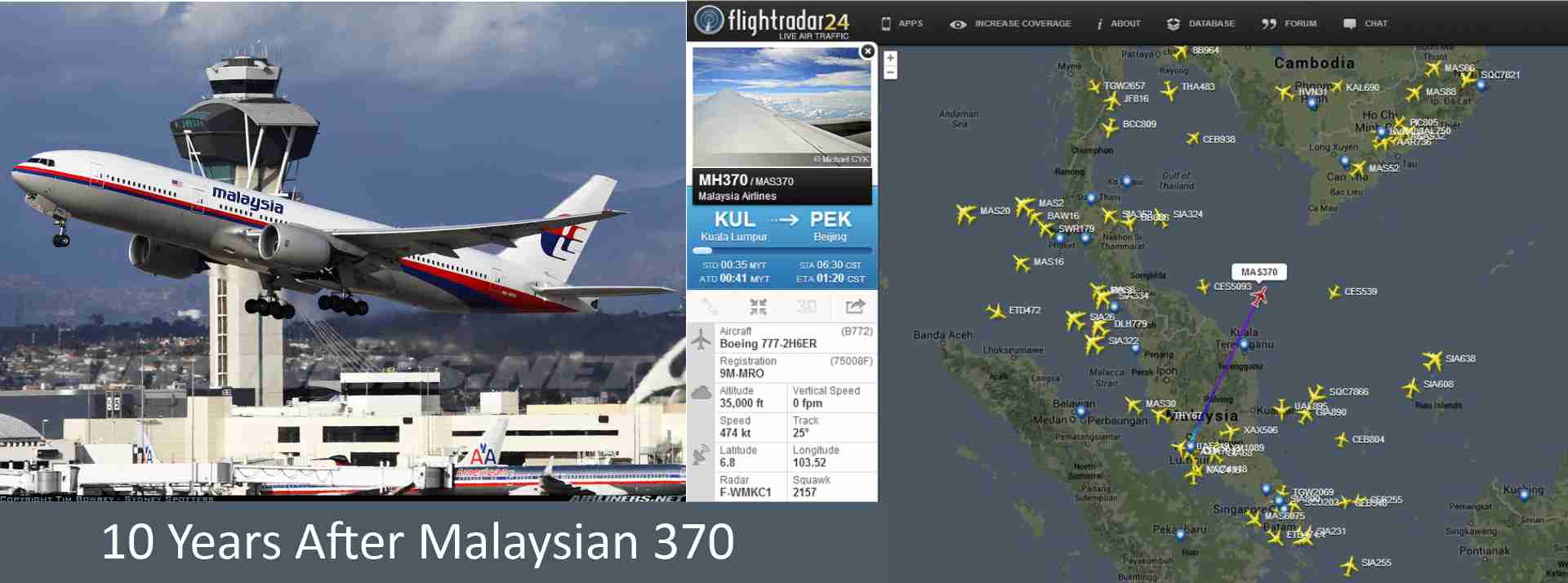
Late Edit: We started a new section of this site dedicated to this subject: <MH370>
Are you interested in the MH370 case? What are the scenarios, and what is their probability? What can be done to avoid a similar case in the future? Which lessons can the aviation community learn from it?
I invite you to join me at the Malaysian 370 Webinar on 27 March 2024 at 12:00 UTC. It is free, but the number of participants is limited. Registration details are given below.
When the Malaysian 370 flight disappeared on 8 March 2014 I was as shocked as anyone else, but unlike anyone else, I had a professional commitment, I was teaching air navigation at the University Politehnica of Bucharest, Faculty of Aerospace Engineering. My students expected me to explain this accident, as I usually do, but this case defied logic and technical common sense. I am passionate about aviation. My background is in aerospace engineering, with a specialization in avionics and navigation systems. I have been teaching air navigation systems since 1992, and in 2009 I founded the Air Navigation program of studies.
I started to look at all the facts and case details, and together with my friends Prof. Cristian Constantinescu and Istvan Barna Jakab (a former student), we tried to find clues to solve this mystery. As early as 20 March 2014 I published an article in Romanian on aviatia.ro portal, and I replied to questions in a national newspaper on 23 March 2014. Re-reading these statements after 10 years is reassuring because, in hindsight, I would not have to change anything in that very early analysis. So we started on the right foot, assuming the accident as hijacking after excluding one by one all other possible explanations that were circulated, like fire, technical problems, downing the aircraft by a missile, etc. Also, I concluded that “as improbable as it may seem, the facts indicate a flight heading to the Southern Indian Ocean”.
In the following months, using only radio signals as recorded by INMARSAT, we calculated the most probable trajectory of the aircraft. On 30 August 2014, I sent to the Australian Transport Safety Bureau (ATSB) our results, which indicated a place 700 NM away from the current search area, south of the Broken Ridge.
On 18 September 2014, we presented these calculations in a plenary paper at the INCAS Aerospatial Scientific Conference, and they were published in the proceedings.

In October we could confront our results with the results of the INMARSAT team, Chris Ashton, Alan Shuster Bruce, Gary Colledge, and Mark Dickinson. Their outstanding paper was published online in the Journal of Navigation on 7 October 2014, and ATSB suddenly changed its search area, centering it on the Ashton et all results. Our results were close to theirs, and still a couple of hundred nautical miles further to South-West. We redid our calculations many times, trying to understand why our results did not match theirs. In the end, we gave up doubting our results and published them in the same journal in July 2015 (online) and in 2016 in print. We got the Richey Medal for the best scientific paper of the year 2016 in the Journal of Navigation, Cambridge University Press.

In 2015, pieces of debris found on various Indian Ocean shores confirmed two major assumptions of our hypothesis: the flight ended by crashing into the sea, and the place of the crash was in the Indian Ocean. Since then, there have been attempts to backtrack the place of the crash from the debris drift on the surface of the ocean, and also a relatively new theory of weak radio signals. We analyzed both and concluded them as not being useful.
Since 10 years is a significant time frame, I invite those who are interested to connect to our work on Malaysian 370, in one of the three following ways:
10 Years After – Malaysian 370 Webinar
27 March 2024 – 12:00 UTC – Speaker: Octavian Thor Pleter
Subjects: What are the MH370 scenarios, and what is their probability? What can be done to avoid a similar case in the future? Which lessons can the aviation community learn from it?
Language: English
Online registration, Webex meeting with 45 minutes interactive presentation, and up to 1 hour and 30 minutes Q&A and discussions.
The webinar is open to the aviation community, and also to non-professional audience, journalists, and the general public. All technical terms will be explained.
Registration is free and requires just an e-mail message to the address MH370questions@gmail.com containing your name and organization, and at least one question about the Malaysian 370 case that you might have. All questions will be given proper consideration.
The number of participants is limited, so please, do not delay registering. Applications are expected between 5 and 25 March 2024. Registration confirmation will be returned by e-mail starting with 20 March 2024.
Air Navigation Book

It will be released in April 2024 by Springer in Aerospace Technology Series:
<Springer Aerospace Technology>
Chapter 11 includes a comprehensive analysis of the Malaysian 370 case.
EASN Research Webinar: 10 Years of Research into the Malaysian 370 Lost Flight
>> Speaker: Octavian Thor Pleter
>> Co-authors: Cristian Emil Constantinescu, Barna Istvan Jakab
17 May 2024 – 14:00 CET
Language: English
Organized by the European Aeronautics Sciences Network (EASN), the webinar will take one hour, presentation plus discussions, with eventual Q&A follow-up by e-mail.
Participants need to be EASN members, scientific researchers, aeronautical engineers, aerospace engineering students. The individual membership fee is €30 annually.
Harmony Jets Openings
Harmony Jets based in Malta hires urgently an aerospace engineer with knowledge of air navigation for the position of dispatcher. Details <here>.
Openings at the Aeroclubul României
Courtesy of CEO pilot eng. George Rotaru (alumnus of the Faculty of Aerospace Engineering) we announce that Aeroclubul României looks to hire young aerospace engineers. Details (in Romanian) <here>. Aeroclubul României is an important aviation...
Presentations and Projects of students
Presentations and Projects of Students On the 9th of January 2019 students of the first year of the Faculty of Aerospace Engineering, the Air Navigation Department presented the final project for the Introduction to Aerospace Engineering course held by the dean of the...
Students Wanted at the Fokker Academy
Fokker Academy was established in March 2017, in the wake of signing the Partnership between UPB Faculty of Aerospace Engineering and GKN Fokker Engineering Romania. In the Fokker Academy, our students learn to design directly from highly experienced engineers,...
Sponsorship S.C. AEROSTAR S.A. Bacau
Sponsorship S.C. AEROSTAR S.A. Bacau On Monday, 20 November 2018, the Faculty of Aerospace Engineering received from S.C. AEROSTAR S.A. Bacau company a sponsorship that comprises cargo aircraft components (taken out of use), such as: actuator for the landing gear,...
Liviu Librescu
Liviu Librescu – the hero from Virginia Tech University- Liviu Librescu is one of the most renowned graduates of the Faculty of Aerospace Engineering from Bucharest, with which we pride ourselves for his academic successes and honors received, but especially for his...
European Space Talks
I We invite our academic community to participate to an important space event organized by the French Institute of Bucharest:
GKN Fokker Engineering Romania
GKN FOKKER ENGINEERING ROMÂNIA hires aerospace engineers. In 2016 we signed a strategic partnership with this prestigious company, which has over ten years of activity in Romania, with many accomplishments in latest generation aircraft design, employing our...
President Klaus Iohannis at the University Politehnica of Bucharest
On 4 October 2018 in the New Aula of the University Politehnica of Bucharest, we celebrated 200 years since Gheorghe Lazar founded the first higher technical school in Wallachia, The Academic School for Philosophy and Mathematics Sciences at the Monastery St....
CATIA Lab
Catia Lab is the laboratory by which UPB - Aerospace Engineering Faculty and ALTEN Delivery Center Bucharest (GECI Engineering Services) lay the foundations of the next generation of aircraft design engineers. We invite all interested students wishing to learn more...
0 Comments